


Welcome to the fiat currency graveyard

Welcome to the fiat graveyard
Every fiat currency launched before the 20th century has either been destroyed by hyperinflation or legally terminated and replaced.
Every. Single. One.
Before I detail how and why, let me share a curious example of the sublime power of artificial intelligence.
In the course of researching this Benchmark email, I asked my current AI assistant of choice, Gemini, to make me an image.
My prompt: ‘A graveyard of Fiat cars’.
I had this clever idea, see.
But not nearly as clever as Gemini’s.
It gave me this:

At first I was disappointed. I’m no expert, but these cars didn’t look like Fiats to me.
Then I looked again.
At the ‘graveyard’ sign. The number plates. The piles of paper money scattered around.
Given what I’d been researching in our chat, Gemini, had, indeed, created a fiat graveyard.
It’s just that the cars represented currencies, like the Roman Denarius and the Zimbabwean Dollar.
Pretty impressive.
I made a slight tweak, just so the cars and currencies matched:

Just to be clear, this email has nothing to do with Fiat cars, and everything to do with fiat currencies.
Specifically, we’re going to take a walk through the graveyard where 99.9% of paper money ends up.
My goal is not to shock you.
But, I can’t promise you won’t find some of what follows shocking — so damning are the numbers when you start looking far enough into paper money’s history.
Fiat money: ‘Let it be done.’
‘Fiat’ is a Latin word. It translates to ‘let it be done’ or ‘it shall be’.
In practice, this describes the proposal we implicitly agree to when we earn, spend, save and invest in any currency not backed by, say, gold.
The government says ‘this piece of paper is money’, and it is.
This works on two key premises.
The first is the law of legal tender. The government simply mandates that citizens accept its currency for all debt, public and private.
The second is taxation. The government requires all taxes paid in this currency.
To do anything, you have to use the fiat money provided by the state.
This contrasts with ‘hard money’, which has value in and of itself, not just because a government says ‘it shall be’.
The US Dollar, for example, before 1933, was a hard money currency, as opposed to fiat.
If you had a $20 bill, you could exchange it at a bank for a $20 Double Eagle gold coin which contained about an ounce of gold.
The paper was a receipt, not money in itself.
Same thing with the British Pound Sterling; before 1931, one pound equaled one pound of sterling silver. This was the system in Britain for centuries.

So what does history tell us about fiat currencies’ performance?
A 0.01% survival rate, and even then…
Civilization’s experiments with fiat money haven’t been a complete failure.
Of the approximately 775 fiat currencies generally accepted to have graced world history to date, only 77% of them have collapsed, failed and disappeared.
Research from Visual Capitalist indicates the median lifespan of a fiat currency is about 27 years.
Interestingly, this is about the length of time we use to define a human generation.
More interesting is the fact that while one study suggests that 599 out of the 775 fiat experiments to date have failed, there have probably been far more than 775.
A broader estimate suggests there have actually been thousands, and that the failure rate is more likely about 99.9% when you include historical currencies no longer in circulation.
It's near-impossible to comprehend how many currencies have come and gone.

Every single fiat currency created before the 20th Century has been either destroyed, or legally terminated and replaced.
So why do they fail?
The vast majority die from hyperinflation.
This is when the government prints so much money that the value and purchasing power falls off a cliff, which historically leads to the currency’s legal termination and replacement, with a new currency at a ‘reset’ value.
And what causes hyperinflation?
Most commonly, it’s when governments try to monetize debt.
Printing money to pay the bills, in other words.
The government prints money to pay a debt.
The extra money causes prices to rise (inflation).
Because prices are higher, the government’s expenses go up (it costs more to pay soldiers or build roads, for example).
The government now has a larger deficit, so it must print even more money to cover it.
This creates a feedback loop, which plays out until the currency hits zero.
Here’s what that looks like in action.
Three fiat deaths worth remembering
‘Those who cannot remember the past are condemned to repeat it.’
Most people will tell you Winston Churchill said that.
But he just made it famous.
Spanish-American philosopher George Santayana owns that one.
Santayana also said: ‘Fanaticism consists in redoubling your effort when you have forgotten your aim.’
Which quite aptly describes the debt-moneyprinting-hyperinflation loop.
So in the spirit of not forgetting fiat currency’s past, here’s two of modern history’s most notorious — and one lesser known, but even more shocking — examples of hyperinflation.
Exhibit A:
Weimar Germany, 1923
The 29,500% Month
The trigger: Following World War I, Germany was saddled with crushing reparations debts it could not pay. When France occupied Germany's industrial heartland (the Ruhr) to seize resources, the German government ordered workers to strike — and printed money to pay them.
4,200,000,000,000:1: This was the exchange rate between the German Mark and a single US Dollar in November 1923. Just ten months earlier, that same Dollar had cost only 17,000 Marks.
The collapse: In the final days, prices doubled every 3.7 days. There is a famous account of a university student ordering a cup of coffee for 5,000 marks, only to find that by the time he finished drinking it, a second cup cost 7,000 marks.
The aftermath: The government scrapped the Mark and replaced it with the Rentenmark, which hit the reset button by cutting 12 zeros off the old currency.
While this stopped the inflation, the damage was done: The German middle class, who had held their wealth in cash and government bonds, was wiped out.
Here’s a 20 million Mark note from 1923:

Exhibit B:
Hungary, 1946
The 100 Quintillion Pengő
The trigger: Post-WWII Hungary was a smoking ruin. With 40% of its national wealth destroyed and the Soviet Union demanding massive reparations, the government had virtually zero tax revenue. So they decided to print the entire national budget.
100,000,000,000,000,000,000: This was the denomination printed on the largest banknote ever issued (the 100 Quintillion Pengő). By the time this note hit the streets of Budapest, it was worth roughly $0.20 USD.
The collapse: At its peak, prices in Hungary doubled every 15 hours. Hyperspeed inflation, if you will. When the government stopped printing, it wasn’t because they’d decided to change monetary policy; they’d run out of paper.
The aftermath: On August 1, 1946, the government swept the Pengő into the gutter (literally, see below) and introduced the Forint. The exchange rate was set at 1 Forint to 400 Octillion Pengő. It remains the most violent mathematical wealth deletion in human history.
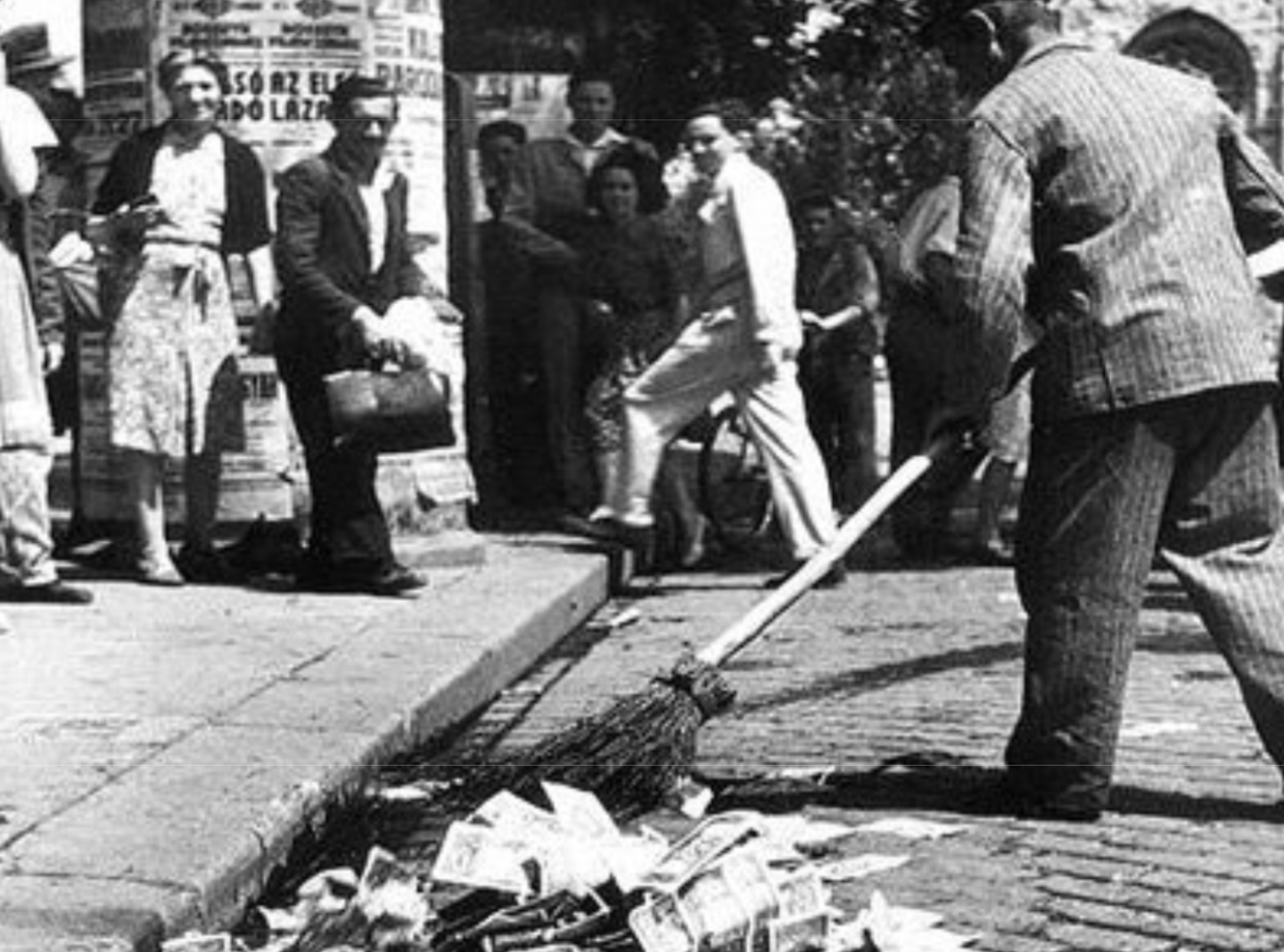
Exhibit C:
Zimbabwe, 2008
The 'Toilet Paper' Standard
The trigger: After a controversial land reform program collapsed the country's agricultural exports, Zimbabwe's tax base evaporated. But the government still had to pay soldiers and civil servants. With no taxes coming in, they — can you guess? — turned to the printer.
100 Trillion Dollars: This was the face value of the now-infamous blue banknote issued in the final days. Despite the astronomical number, it could barely pay for a bus fare in the capital, Harare.
I’m the proud owner of one of these pieces of monetary history:

The collapse: In 2008, a sign in a Zimbabwean public restroom read: ‘Toilet paper only to be used in this toilet. No cardboard, no cloth, no Zimbabwe Dollars’. The face value of the note had dropped below the cost of the raw paper.
The aftermath: The government finally gave up the illusion. In 2009, they formally abandoned their own currency and legalized the use of foreign cash. The 100 Trillion dollar notes are now worth more as collectibles than they were as legal tender.
These are just three of hundreds, perhaps thousands, of stories of fiat currency collapse.
Money that lost its value faster than it took to drink a cup of coffee.
Money that ended up swept into the gutter.
Money that ended up worth less than toilet paper.
But not all fiat has vanished in such circumstances.
The fiat ‘winners’ circle
Most fiat currencies lose. But what about the winners?
The US Dollar and the British Pound are two currencies that have — so far — bucked the trend.
The Pound is actually the oldest continuously-used currency in the world.
In use since about 800 AD, for most of its life, ‘Sterling’ meant exactly that; one pound of sterling silver.
In 1931, the British government decoupled the Pound from silver.
The trajectory since then is what you’d expect.
The Pound has lost more than 99% of its purchasing power:

What cost £1 in 1913 would require more than £100 today.
Then there’s the current global reserve currency, the US Dollar.
You can think of the dollar as the cleanest shirt in the dirty laundry basket.
It is strong only relative to other dying paper currencies.
Since the creation of the Federal Reserve in 1913, the Dollar has lost ~97% of its purchasing power.

A $20 bill in 1930 could be exchanged for an ounce of gold. Today, that same ounce of gold costs roughly $5,000.
So success, in fiat terms, isn’t really about holding value, just losing it slowly enough that the public doesn’t notice — or start using it as toilet paper.
This week's quote:
'Paper money eventually returns to its intrinsic value: Zero.'
— Voltaire
Invest in knowledge,
Thom
The Benchmark
Read more: Rome, JFK, and abandoning the gold standard.
Share this: If you've enjoyed reading, forward this email to someone you know would enjoy, too.
New here? Subscribe to The Benchmark.


